How to Play Krillion Infinite
Krillion Infinite gives you seven prompts a day and 25 seconds on each one. Everyone playing that day gets the same seven. The scoring runs backwards from most quiz games: the answer that arrives first is worth almost nothing, and the further your answer sits from what everyone else typed, the deeper you sink.
You do not need an account, an app, or a payment to play Krillion. Open Krillion, press BEGIN DIVE, and the clock starts on the first prompt. A dive takes about four minutes.
What you need to play Krillion
A browser and four minutes. There is nothing to install, nothing to sign up for, no payment, and no email address to hand over. Krillion runs in the page you are already looking at the site with, so the gap between deciding to play and being mid-round is one button.
It plays the same on a phone as on a desktop — the answer box takes the on-screen keyboard, and the diver column reflows rather than shrinking. You do need a connection while you play, because the day's prompts and the judging of each answer come from the server rather than sitting on your device. Everything after that is local: your progress through today's dive, your history, and the record that you have already dived, all kept in the browser you played in.
The one rule that matters
A prompt reads name a cheese. You have a cheese in mind already — everyone does, and that is the problem. Cheddar is worth 10 points. Taleggio is worth 85. Both are correct, both take the same three seconds to type, and one of them is eight and a half times the dive. Every other rule on this page is detail hanging off that.
This is why a first dive so often feels like a failing grade. Seven correct answers can land you at 70 points when the board goes to 700. Nothing was wrong with the answers. They were just the answers everybody else gave.
How to play a round, second by second
- The prompt appears and the 25-second clock starts immediately. There is no ready check.
- You type an answer and submit. There is no limit on attempts.
- A hit ends the round, shows the tier you landed in, and sinks the diver by that much.
- A miss costs you a slice of the clock and nothing else. The round stays open.
- If the clock runs out, the round scores zero. It is not scored as a penalty tier — it is simply not scored.
Because a miss costs time rather than the round, guessing is correct play. A word you are only half sure is a real cheese is worth typing; the downside is a second or two, and the upside is 85 points.
How to concede a round
You can concede a round, but not for the first 15 seconds. An instant concede would be a skip button, and a skip button turns a dive into a quiz you can rush through. You have to actually run out of ideas first.
What Krillion counts as a correct answer
Answers are matched loosely, on purpose. A missing accent, a doubled letter, a stray plural, British against American spelling — all of these still land. You are being scored on what you thought of, not on whether you can spell it under a clock.
What will not land is an answer nobody put in the bank. Each prompt carries a hand-built list, most of them well past 150 entries deep, and if your answer is genuinely valid but missing, the game logs the rejection so it can be added. That is the single most useful thing you can send to contact.
How a Krillion round is scored
Every answer in a prompt's bank is filed by how widely known it is, and that filing is what pays you. Using the real name a cheese bank, which holds 169 accepted answers:
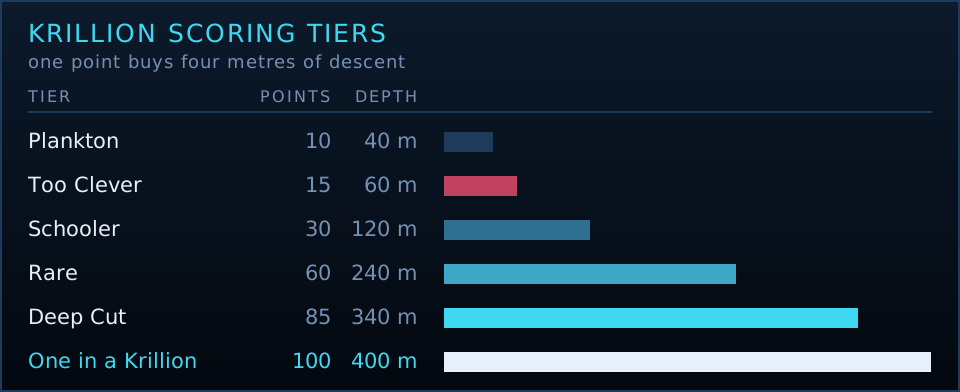
| Tier | Example | Points | Depth |
|---|---|---|---|
| 🫧 Plankton | Cheddar | 10 | 40 m |
| 🤡 Too Clever | a famously “obscure” pick | 15 | 60 m |
| 🐟 Schooler | Gouda | 30 | 120 m |
| 🐙 Rare | Manchego | 60 | 240 m |
| 🦑 Deep Cut | Taleggio | 85 | 340 m |
| 🌟 One in a Krillion | one designated answer, never published | 100 | 400 m |
Only four of those 169 cheeses are Plankton. Step off that handful and you are paid properly straight away — the shallow end is a cliff, not a slope. The scoring page has the full arithmetic, including how the bands are cut and why Too Clever pays less than an honest guess.
A first dive, played through
The prompt lands: name a cheese. Cheddar arrives about a second later, unbidden. Type it and the round is over at 10 points and 40 m, three seconds into a 25-second clock. That is the whole trap, and a first dive usually falls into it seven times in a row.
Now play the same round the other way. Let cheddar go past. Mozzarella and brie are queued up behind it and they pay the same 10, because the four Plankton answers in that bank are exactly the four a room would shout in unison. Gouda is better at 30. Manchego, maybe eight seconds in, is 60. Taleggio is 85 — and so are 134 of the 169 cheeses in the bank, because the hard part was never being obscure. It was thinking of anything at all while a clock ran.
So the round you want takes twelve seconds rather than three. The first few go on refusing the answer that came free, the next few on walking somewhere less crowded — a country you have not used yet, a texture, the far end of a cheeseboard — and then you type the first thing you find there. Seven rounds played that way is a 400-point dive instead of a 70-point one, and the whole difference sits in what you did not type. The strategy page turns that into seven habits.
Depth, not a mark out of 700
Each point sinks you four metres, so the dive is reported in metres. Seven perfect answers would be 700 points and 2,800 m of water, which is the trench floor. Nobody reaches it. That is not what it is for — it is the ceiling that keeps a genuinely excellent dive from looking finished.

How often you can play: one dive a day
The set changes at 00:00 UTC and there is one dive per day per browser. Refreshing does not cost you the day; your progress is kept on your own device, so you can close the tab mid-round and pick it up. Clearing site data does erase it, permanently, because there is no server-side copy.
If four minutes a day is not enough, Infinite is the mode without the daily gate: one tank of air, prompts drawn from the whole bank, and rare answers buy seconds back instead of ending a round.
How to share a dive without spoiling it
The result screen gives you an emoji strip — one square per round, coloured by the tier you hit — plus your depth. It contains no answers, so posting it spoils nothing for anyone who has not dived yet.
That is the whole point of the strip: everyone who played today saw the same seven prompts, so two strips side by side are directly comparable, round for round, without either person giving away a single word. A row of pale squares and a row of dark ones tell the same story the depths do, and they read at a glance in a group chat.
评论
发表评论